Profile of Masahiro Morioka
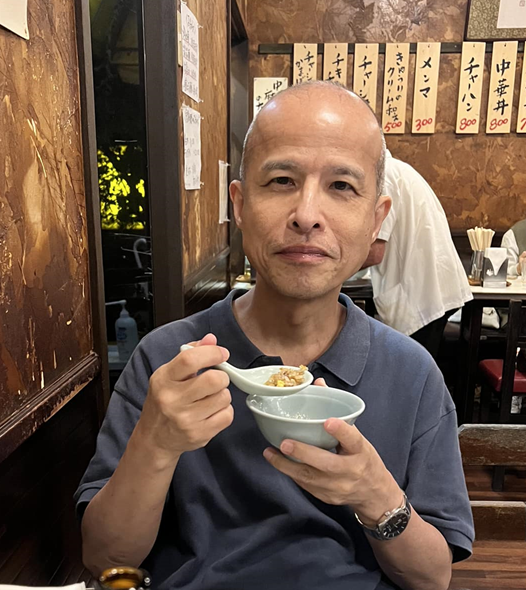
Masahiro Morioka 2024
Overview
Masahiro Morioka, a professor of philosophy and ethics at Waseda University, Japan, is considered by many to be one of the most influential thinkers in the current Japanese philosophical community. He is the organizer of Tokyo Philosophy Project  , and the editor-in-chief of Journal of Philosophy of Life . He specializes in philosophy of life, life studies, bioethics, gender studies, and criticism of contemporary civilization. Although a majority of his books and papers have been published only in Japanese, you can read some of his English papers, essays, and books on this website. , and the editor-in-chief of Journal of Philosophy of Life . He specializes in philosophy of life, life studies, bioethics, gender studies, and criticism of contemporary civilization. Although a majority of his books and papers have been published only in Japanese, you can read some of his English papers, essays, and books on this website.
In 1988 he coined the phrase "life studies" in his first book as a result of his frustration with the "bioethics" and "environmental ethics" that were prevalent in the US at that time. What was most important, he thought, was to seek the meaning of life and death in a contemporary society in which everyone seemed to be looking for transient pleasure and superficial freedom. He began to believe that along with criticism of contemporary civilization there was also a need for a fundamental reconsideration of the relationship between life and technology. (See What is life studies)
In 2018, philosophers specializing in meaning in life, including Morioka, established the International Conference on Philosophy and Meaning in Life, which has become one of the most well-known international conferences on the philosophy of life’s meaning..
His writings include twenty+ books and more than a hundred papers in Japanese and in Engish. He is a regular commentator in major Japanese newspapers.
Interview
His profile is concisely presented in the 2025 interview with him published in Corriere della Sera 7.
Masahiro Morioka, the Philosopher and the Secret of the “Small Happiness” That Saves Us from Suffering.
Writings
Morioka was born in Kochi Prefecture, Japan, in 1958. He graduated with a B.A. from the University of Tokyo in 1983. His specialization was analytic philosophy, especially the later writings of Ludwig Wittgenstein, and he became one of the earliest specialists on bioethics in Japan. He worked for the International Research Center for Japanese Studies as a research associate for eight years, a period during which he published several books. Brain-Dead Person (1989) is one of the most influential books in Japanese bioethics. Consciousness Communication (1993), a study of the psychological aspects of computer-mediated-communications, won the Telecom Social Science Award . Reconsidering the View of Life (1994) was warmly welcomed as an introductory textbook on applied ethics for high school and college students. How to Live in a Post-Religious Age (1996) was written as a reaction to the 1995 Sarin gas attack by the Aum Shinrikyo cult on several subway lines in Tokyo. The message of that book was widely supported by young people seeking the meaning of life and death in our chaotic society. He spent one year as a visiting scholar at Wesleyan University , Conncticut, USA, in 1991.
In Life Studies Approaches to Bioethics (2001) he examines the fundamental concepts of life studies and applied them to contemporary bioethical issues. The Japanese feminist and disabled people's movements in the 1970s are examined as important early examples of Japanese bioethics. He then published another controversial book on the fate of contemporary civilization, Painless Civilization: A Philosophical Critique of Desire (2003). This has probably been his most important book so far. Many reviews and criticisms of this text appeared in major newspapers and magazines. Morioka then published two books on sexuality. Confessions of a Frigid Man (2005), a philosophical analysis of male sexuality, provoked a variety of emotional reactions from readers. The other, Lessons in Love for Herbivore Men (2008), is a how-to textbook for timid, gentle-hearted young men. The term "herbivore men" (soshoku kei danshi in Japanese) became a buzzword in Japan and was ranked among the top ten keywords-of-the-year for 2009 (See Special Report on herbivore men). In 2013 he published Manga Introduction to Philosophy. In this book he drew all the original cartoons himself. This book is now considered to be a unique and original introduction to contemporary philosophy and its hard problems.
Morioka moved to the School of Human Sciences, Waseda University in 2015. He established Tokyo Philosophy Project in 2016, and launched Tokyo Philosophy Lab, a series of philosophical lectures for the general public, with Saori Tanaka . He edited two collections of papers Reconsidering Meaning in Life: A Philosophical Dialogue with Thaddeus Metz in 2015 and Nihilism and the Meaning of Life: A Philosophical Dialogue with James Tartaglia in 2017.
He published Would It Be Better Never to Have Been Born? in Japanese in 2020, which discusses the philosophy of antinatalism and its relationship with the philosophy of life. This book stirred controversy in the Japanese language Internet and Japanese mass media. He published two English articles: What Is Antinatalism?: Definition, History, and Categories and What Is Birth Affirmation?: The Meaning of Saying “Yes” to Having Been Born in 2021. He published a collection of his English papers What Is Antinatalism? And Other Essays: Philosophy of Life in Contemporary Society (open access book) in 2021. He is also investigating the phenomenological concept of animated persona (See Animated Persona: The Ontological Status of a Deceased Person Who Continues to Appear in This World).
Tranlsations
His books have been tranlsated (and are being translated) into several languages:
*Confessions of a Frigid Man: A Philosopher’s Journey into the Hidden Layers of Men’s Sexuality
>> English, Korean, Chinese (traditional Chinese character)
*Manga Introduction to Philosophy: An Exploration of Time, Existence, the Self, and the Meaning of Life
>> English, Turkish (in progress), French, Spanish, Persian
*Painless Civilization
>> English (Chapter 1-3), Korean, Turkish (Chapter 1-3), Chinese (in progress)
*How to Live in a Post-Religious Age: Terrorism, Philosophy, and the Meaning of Life
>> English
*Would It Be Better Never to Have Been Born?
>> Chinese (traditional Chinese character)
*Lessons in Love for Herbivore Men
>> Chinese (traditional Chinese character), Chinese (simplyfied Chinese character), Indonesian (in progress??), Egyptian (in progress??)
If you have an interest in translating Morioka's books into your native language and publish them in the form of commercial publication or open access PDFs, please cotact him.
Masahiro Morioka on Twitter

Masahiro Morioka | Facebook

Curriculum Vitae
Masahiro Morioka
First Name: Masahiro
Last Name: Morioka
Year of Birth: 1958
Place of Birth: Kochi Prefecture, Japan
Citizenship/Nationality: Japanese
Languages: Japanese, English
Sex: Male
Address: Saitama Prefecture, Japan
Education:
2015 Ph.D. (Human science) Graduate School of Humanities and Social Sciences, Osaka Prefecture University
1985 M.A. (Ethics) Graduate School of Humanities, The University of Tokyo
1983 B.A. (Ethics) The University of Tokyo
Current Positions:
2015- Professor of philosophy and ethics at the School of Human Sciences, Waseda University, Japan.
2015- Organizer of Tokyo Philosophy Project
2015- Director of Waseda Institute of Life and Death Studies
2015 Emeritus professor at Osaka Prefecture University
2010- Editor-in-chief, Journal of Philosophy of Life
Previous Positions:
2017 Adjunct lecturer of philosophy at the University of Tokyo
2015-2017 Visiting scholar at the Research Institute of Environmental Philosophy and Philosophical Anthropology, Osaka Prefecture University
2005-2015 Professor of philosophy and ethics at the College of Humanities and Social Sciences, Osaka Prefecture University, Japan
2014-2015 Adjunct lecturer of philosophy at Kyoto University
1998-2004 Professor of philosophy and ethics at the College of Integrated Arts and Sciences, Osaka Prefecture University, Japan
2001-2003 Visiting Professor at the Graduate School of Humanities and Sociology, University of Tokyo
1997-1998 Associate Professor at Osaka Prefecture University
1988-1997 Research Associate at the International Research Center for Japanese Studies, Japan
1991 Visiting Scholar at Wesleyan University, U.S.A.
1988 Research Associate at the University of Tokyo
Award:
1994 Telecom Social Science Award (for Consciousness Communication)
Major Publications (Listed below are only Japanese books. For the complete list of publications visit here. English papers here.)
2022 Philosophizing Life Counseling (Ikinobiru Books)
2020 Would It be Better Never to Have Been Born? (Chikuma Shobo)
2013 Manga Introduction to Philosophy (Kodansha)
2012 Connecting the Living and the Deceased (Shunju Sha)
2009 The 33rd Stone: A Philosophy for a Wounded Age (Shunju Sha)
2008 Lessons in Love for Herbivore Men (Media Factory)
2005 Confessions of a Frigid Man: A Philosopher’s Journey into the Hidden Layers of Men’s Sexuality (Chikuma Shobo)
2003 Painless Civilization: A Philosophical Critique of Desire (Transview Publications)
2001 Life Studies Approaches to Bioethics: A New Perspective on Brain Death, Feminism, and Disability (Keiso Shobo)
2001 Life Torn Apart (kinokopress.com)
1997 An Intellectual Method of Facing Oneself (PHP Publications)
1996 How to Live in a Post-Religious Age (Hozokan)
1994 Reconsidering the View of Life (Chikuma Shobo)
1993 Consciousness Communication (Chikuma Shobo)
1989 Brain-Dead Person: Human Relationship-Oriented Analysis of Brain Death (Tokyo Shoseki)
1988 An Invitation to the Study of Life (Keiso Shobo)
Essay in Lifeline
This is a brief interview published in the column "lifeline" in the medical journal Lancet Vol.356, No.9239, Oct.21, 2000.
Lifeline
Masahiro Morioka
Lancet, Issue: Oct. 21, 2000
Masahiro Morioka studied medical ethics at the University of Tokyo. He is absorbed in "life studies", a transdisciplinary research field concerning life, death, and nature. He is a professor of philosophy at Osaka Prefecture University, and the director of the International Network for Life Studies.
Who was your most influential teacher, and why?
The Austrian philosopher, Ludwig Wittgenstein, because he taught me the essence of philosophy.
What is your greatest regret?
I was born and brought up as a male. This is my greatest regret.
What complementary/alternative therapies have you tried? Did they work?
Ki-ko, traditional Chinese martial arts. It worked to an extent.
Do you believe there is an afterlife?
If there is afterlife, it must be life after this life, hence it is not real afterlife.
What are you currently reading?
Papers on brain death.
What books are you not reading?
"One hundred ways to save this planet".
Do you believe in capital punishment?
Never.
What do you think is the most exciting field of science at the moment?
Brain sciences.
Do you apply subjective moral judgments in your work?
Yes, of course.
What do you think is the greatest political danger to the medical profession?
Capitalism and its temptation to make money out of medical inventions.
If you had not entered your current profession, what would you have liked to do?
I wanted to be a sculptor and create very experimental three-dimensional works.
Where were you in your sibling order, and what did you gain or lose as a result?
The eldest brother. I gained mother's love and lost all my adolescence.
Do you believe in monogamy?
Yes I believe in it, but the truth is sometimes a heavy burden.
COPYRIGHT 2000 The Lancet Ltd.
COPYRIGHT 2000 Gale Group
|